

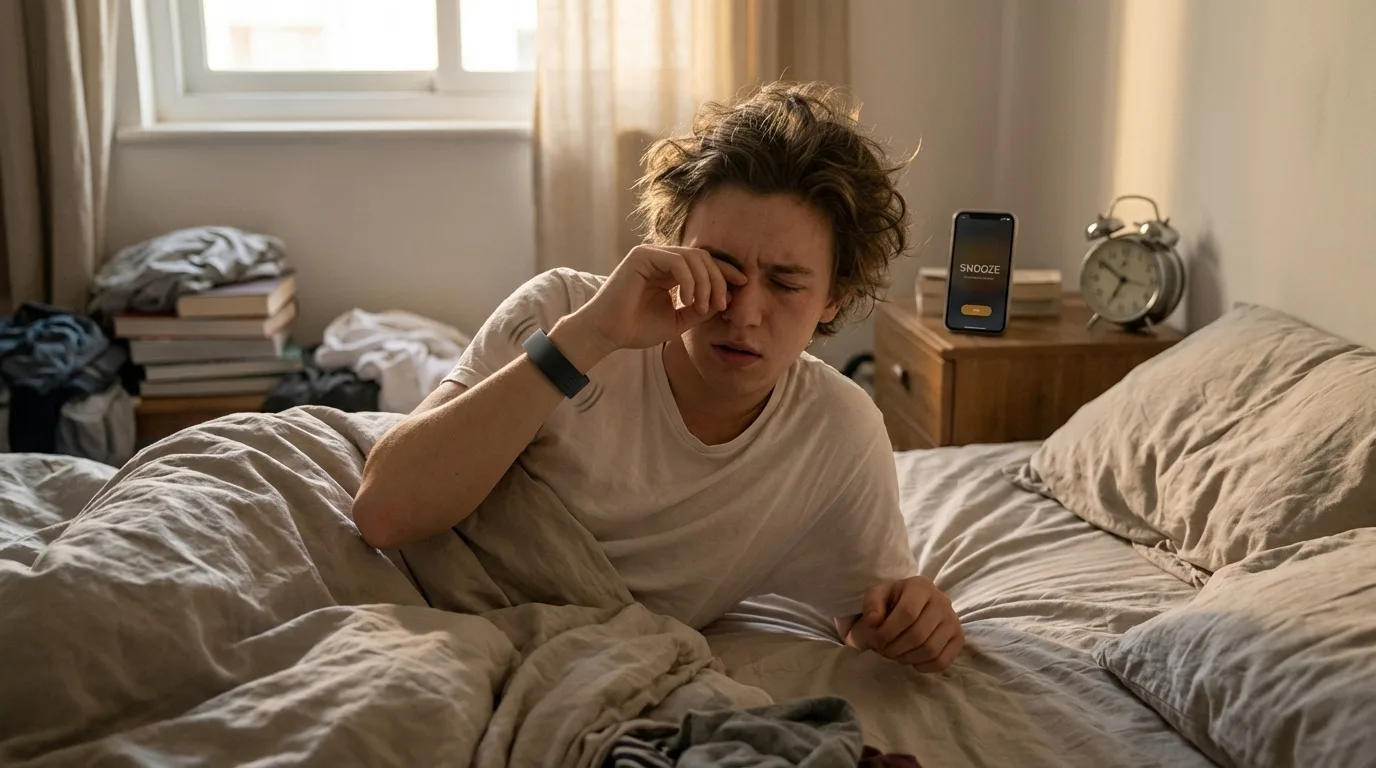
To stop sleeping through alarms, start by fixing the highest-leverage problems first: chronic sleep debt, inconsistent bed and wake times, too many easy-to-ignore alarms, and alarm cues that are happening in the wrong channel. If sound alarms keep failing, a direct vibration cue can work better than just turning the volume up again.
If you are searching this, you probably have already tried the obvious stuff. More alarms. Different ringtones. Louder volume. Putting the phone across the room. Asking someone else to wake you up. And if you are still here, it is probably because those fixes have not actually fixed the pattern.
That matters, because repeated alarm failure is usually not a character issue. It is either a sleep issue, a setup issue, or a signal issue. Once you know which one you are dealing with, the solution gets much clearer.
Why do people sleep through alarms in the first place?
People usually sleep through alarms because they are running on too little sleep, waking from deep sleep with strong sleep inertia, or using an alarm setup their brain has already learned to ignore. In other words, the alarm may be happening, but the body is still not ready to transition into action.
That can happen for a few different reasons at once:
- you are not getting enough sleep consistently
- your sleep schedule shifts late and makes the wake time fight your circadian rhythm
- you have trained yourself to treat alarms as background noise by stacking too many of them
- you snooze or dismiss alarms half-awake without forming a real wake-up transition
- sound simply is not the most effective cue for your mornings anymore
The useful reframe
Sleeping through alarms can feel embarrassing, but it is often a system problem. The most effective fix is usually the one that changes the system rather than asking for more effort from a half-asleep brain.
How to stop sleeping through alarms: 7 practical fixes
The best way to stop sleeping through alarms is to work from the most foundational fix to the most mechanical one. That keeps you from skipping straight to louder gadgets when the real issue is sleep debt — or from chasing perfect sleep hygiene when the wake-up signal itself is clearly wrong.
1. Protect your actual sleep opportunity
The most boring fix is still one of the biggest. If you are consistently trying to wake up before you have had enough sleep, your body will keep treating the alarm like an interruption rather than a normal transition. For teens and young adults especially, late sleep timing can make early alarms feel brutal even when motivation is high.
2. Keep the wake time more consistent than the bedtime
A stable wake time often matters more than chasing a perfect bedtime every night. When wake time drifts wildly, the body never gets a predictable signal for when morning actually starts. If you want fewer missed alarms, anchoring the wake time helps reduce that chaos.
3. Stop layering endless alarms
Multiple alarms can feel responsible, but for many people they create the opposite effect. A long runway of alarms teaches the brain that the first few do not matter. If your routine is ten alarms over forty minutes, that may be training you to stay asleep longer, not wake earlier.
4. Make the first alarm harder to dismiss mindlessly
If you are the kind of person who turns alarms off half-conscious, the setup matters as much as the sound. Placing the phone farther away, using fewer alarms, and forcing one real physical action can help when the main problem is reflexive snoozing rather than full sound filtering.
5. Match the alarm type to the failure point
If the problem is harsh wake-up shock, light-based alarms may help. If the problem is automatic snoozing, task-based alarms may help. If the problem is that sound itself keeps failing, a bed shaker or wearable vibration alarm is often the more logical next step.
6. Reduce the stuff that makes mornings harder than they need to be
Late caffeine, inconsistent sleep timing, all-night scrolling, and waking from a dark room straight into a stressful morning all make alarms easier to lose. You do not need a perfect sleep routine, but you do need to stop feeding the exact pattern you are trying to break.
7. Switch channels if sound alarms are clearly not working
If you have already tried normal alarm advice and still keep missing mornings, the answer may be to stop relying on sound as the main cue. A direct vibration cue on the wrist or bed can be more effective for some deep sleepers because it changes the wake-up pathway instead of just increasing volume.
| Wake-up problem | What usually helps most | What often fails |
|---|---|---|
| Chronic sleep debt | More consistent sleep and wake timing | Just adding louder alarms |
| Half-asleep snoozing | Fewer alarms and more physical friction | Ten easy alarms in a row |
| Sound gets ignored | Bed shaker or wearable vibration | More ringtone experimentation |
| Shared-room stress | Personal vibration or gentler wake-up options | Room-filling loud alarms |
Does putting your alarm across the room actually help?
Putting your alarm across the room can help if your main issue is hitting snooze reflexively and staying in bed. It forces a transition from lying down to standing up, which gives you a better chance of fully waking.
But it is not a universal fix. If you regularly turn alarms off half-awake, walk back to bed without remembering it, or sleep through the sound entirely, distance alone may not solve the real problem. In those cases, the question is less about where the alarm is and more about what kind of signal it is.
When does a vibrating alarm make more sense than another loud alarm?
A vibrating alarm makes more sense when you have already proven that sound alarms are unreliable for your mornings. That includes deep sleepers, teens who sleep through repeated alarms, ADHD mornings where sound becomes background noise, and shared-room situations where louder alarms punish everyone except the sleeper.
That is why some people do better with a wearable option like a vibrating wrist alarm. The wake-up cue happens directly on the body instead of somewhere else in the room, which can feel much harder to tune out.
What if this keeps happening to a teen or someone with ADHD?
Teens and ADHD sleepers often get judged as if the problem is attitude, but the morning pattern is usually more complicated than that. Teen circadian timing tends to drift later, and ADHD mornings can come with stronger routine friction, sleep inertia, or automatic snoozing behavior.
If that is the situation, it helps to stop framing the issue as “just try harder.” A better next step is building a setup that matches the pattern. That may mean reading more about why teens sleep through alarms, or comparing different wake-up formats like those in our ADHD alarm clock guide.
What should you try if nothing else has worked?
If you have already cleaned up the easy wins and still keep sleeping through alarms, the next step is usually not another louder phone alarm. It is trying a different wake-up mechanism. That is where Dawn Band fits: it is built for people who need a wearable vibration cue instead of one more sound in the room.
If that sounds closer to your real problem, you can also read our explanation of why people sleep through alarms or go straight to see how Dawn Band works.
Need a wake-up method that is harder to ignore?
If normal sound alarms keep failing, Dawn Band gives you a direct vibration cue on the wrist instead of one more noise to sleep through. It is a better fit when the problem is wake-up reliability, not just alarm volume.
Sources and references
FAQ
Why do I sleep through alarms even when they are loud?
Volume is only one part of the equation. If you are sleep-deprived, waking from deep sleep, or used to tuning alarms out, a louder sound does not always solve the real problem. Sometimes it just creates more stress for everyone else in the room.
Can sleeping through alarms be a sleep schedule issue?
Yes. If your sleep timing is consistently late or irregular, the alarm may be hitting you at a biologically bad moment. That is especially common in teens, shift workers, and people who are constantly trying to catch up on sleep.
Is it better to use one alarm or many?
For many people, fewer better-placed alarms work better than a long chain of alarms. Endless alarms can train the brain that the first few do not matter, which makes the whole setup weaker over time.
What if I keep turning alarms off in my sleep?
That usually means the setup is too easy to dismiss half-conscious. Physical friction helps, but if it keeps happening, a different wake-up channel like vibration may be more reliable than another phone alarm routine.